


Your shopping cart is empty!
Transparent adhesive tape for protection against crawling garden pests "Bio Plantella" (glue band)
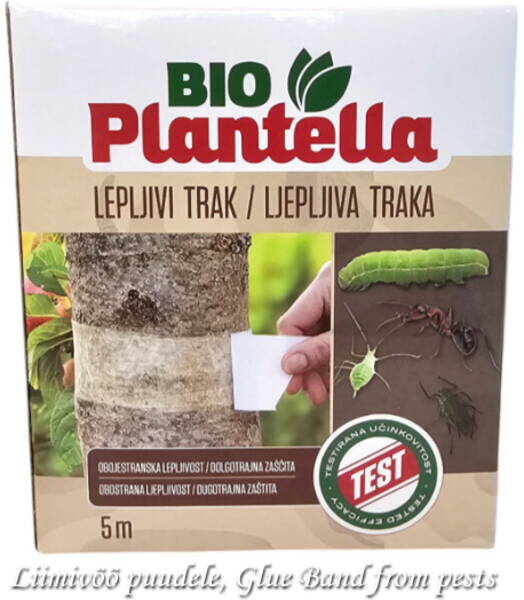
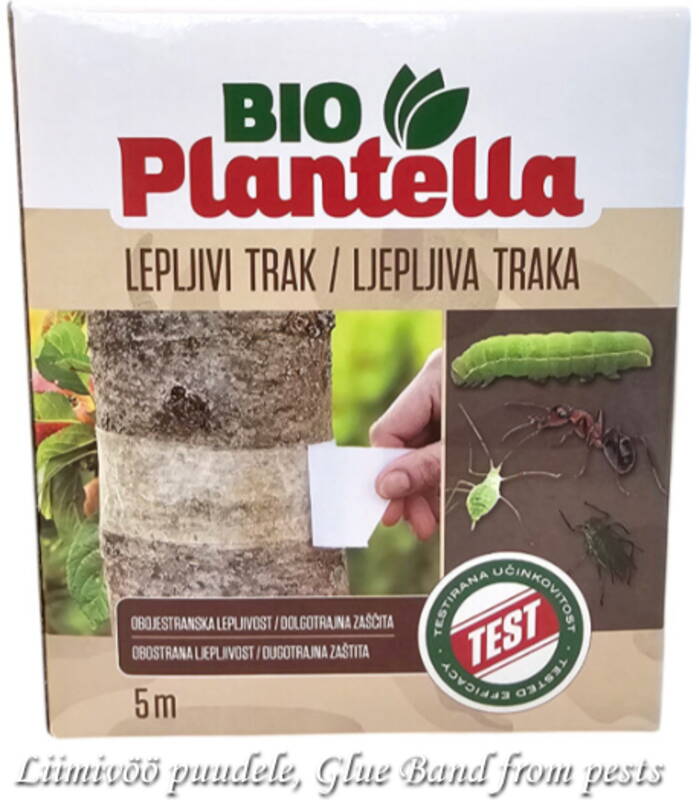
Double-sided transparent adhesive tape (glue band) "BioPlantella" — a reliable and natural solution for the mechanical protection of fruit trees and shrubs against crawling garden pests:
- only insects attempting to crawl across it stick to the glue coating;
- completely free of toxic chemicals;
- safe for beneficial flying insects like bees (pollinators visit flowers, not trunks, and the transparent color does not attract them);
- allows for effective monitoring of pest emergence in the garden.
The 5 cm wide sticky trap creates an impenetrable natural barrier, stopping small winter moth caterpillars, ants, aphids, soil-emerging beetles, and other pests from reaching the tree canopy. It is very durable and does not harm the plants themselves.
Instructions for use:
Tightly wrap the tape around the trunks and branches of trees, as well as the supporting stakes of trees and shrubs. Then, peel off the protective paper from the outer side. This tape can be used for plant protection year-round, simply replacing it when the surface becomes densely covered with pests or debris.
The sticky glue band effectively catches many pests, including particularly dangerous ones:
- Winter moth (Operophtera brumata) – one of the main pests of fruit trees;
- Ants (Lasius sp., etc.) – known for spreading colonies of leaf aphids;
- Woolly apple aphid (Eriosoma lanigerum) – weakens trees and reduces frost resistance;
- Nut weevil (Curculio nucum) – significantly reduces crop yields;
- European shot-hole borer (Xyleborus dispar, etc.) – parasitizes various tree species by boring into the wood;
- Pale brindled beauty (Apocheima pilosaria) – damages various deciduous plants, including fruit trees;
- Black cherry aphid (Myzus cerasi, Myzus prunavium) – the sticky band will prevent not only the initial attack of this pest but also its subsequent expansions.
* Small but voracious insect pests can deprive you of a large part of your harvest. To combat them, scientists regularly develop new, increasingly powerful pesticides. However, many gardeners are against the use of any "chemicals" on their plots.
So how do you protect your garden without using insecticides? There is an effective, decades-tested means of controlling harmful insects in the garden – the grease/glue band. It effectively helps fight codling moths, leafrollers, weevils, and other crawling insects (or those forced to crawl before it gets warm), significantly reducing their population.
A sticky band is a trap used to protect fruit trees from insects moving up the tree trunk (from the soil to the canopy) and down (from the canopy to the soil). Among them are such dangerous pests as:
- caterpillars,
- weevils,
- aphids,
- apple blossom weevils,
- leaf weevils,
- apple fruit weevils,
- mites.
When to apply and remove the sticky band.
For the sticky band to show its maximum effectiveness, it must be installed on the tree in a timely manner.
In early spring, when the snow melts and the top layer of soil thaws, insects wintering in the ground wake up and head up the trunk in search of housing and food (which are leaves, flowers, and fruits). It is at this moment that we must be on alert and stop the insatiable crowd of pests. In temperate zones, such a period comes around mid-April. Consequently, the sticky bands should already be attached to the trees before this time. This means they should be applied in early spring when the snow melts and the air temperature begins to rise to +5...+7°C.
Attention: sticky bands are installed at a height of 30-60 cm from the ground, always below the canopy. If tall grass grows near the tree, the sticky band should be applied about 20 cm above it. -
Pros and cons of sticky bands.
The pros of sticky bands include the following: - Eco-friendliness. Sticky bands do not cause any harm to humans, animals, or the environment, unlike chemical insect pest control methods.
- Effectiveness. Despite the seemingly simple design, sticky bands help significantly reduce the number of garden pests and thus achieve a healthy harvest.
The cons of sticky bands: - Labor-intensive. Making and installing sticky bands, especially on a large number of trees, is a long and laborious process.
- Need for regular maintenance and replacement. Any sticky band, regardless of design, must be inspected every 2-3 days (or even better – daily) and cleaned of insects caught in it. In addition, the material needs to be replaced with a new one from time to time. For example, when the structure has been damaged during strong winds or rain. Or if the sticky band is completely filled with insects – in this case, it ceases to "cope" with its functions.
- Danger to beneficial insects. Unfortunately, not only harmful but also beneficial insects (for example, ladybugs) get caught in sticky bands, which leads to a decrease in the population of natural garden defenders.
Simple and effective recipes from our ancestors for pest control on fruit trees.
All gardeners wait for the harvest, while all the pests: aphids, codling moths, weevils, moths, and other parasites dream of eating this harvest!
To ensure these insects don't leave you without fruit on your trees - make a bait trap: it is easy to make from various parts of a plastic bottle.
Cut off the top of the bottle;
Make two holes on the sides, passing a wire through them;
Hang it on fruit trees and shrubs (on such large trees as an apple or pear, you can and should place a larger number of traps: two or three);
Natural kvass or beer acts as a natural bait (by the way, any liquid that has undergone a fermentation process can be used as a bait; the recipe for homemade kvass is very simple: 300 g of bread, preferably rye, 10-20 g of yeast, 100 g of sugar).
Pour this attractant into the traps and wait: the daily catch of insects from such a trap is up to 40% of the pests living on the tree (it is advisable to add a fresh portion of kvass every day). The trap practically does not attract beneficial insects.